Temporal Graph Learning · Fraud Detection
Temporal GNN for Blockchain Fraud Detection
A temporal-graph research build comparing TGAT-style structural reasoning with an optimized XGBoost baseline under a documented synthetic-validation protocol.
Synthetic-validation benchmark · modelling trade-offs clearly labelled
Temporal-graph modelling trade-off
TGAT improves predictive quality in the documented synthetic-validation run while requiring greater latency and memory than XGBoost.
Scope
Role and problem
My role: Built and documented a temporal-graph modelling pipeline and comparative validation path. Public claims are limited to the uploaded synthetic-validation report.
Fraud and anomalous interactions are relational and time-dependent. Flattened tabular features can be fast, but they may lose higher-order structural context as interactions evolve across a network.
Architecture
System flow
Temporal interaction stream
Rolling tabular features
XGBoost baseline
Continuous-time encoding
TGAT-style attention
Dynamic link prediction
Latency and memory trade-off analysis
Evidence
Measured signals
98.42%
Wikipedia-profile TGAT AUC-ROC
Synthetic-validation result from the uploaded comparative report.
94.20%
Enterprise-profile TGAT AUC-ROC
Synthetic-validation result on the higher-complexity transaction profile.
31.5–78.9 ms
TGAT latency range
Per-batch inference latency across the three synthetic-validation profiles; XGBoost remains substantially faster.
Public scope: The public benchmark is a synthetic-validation run. It demonstrates modelling trade-offs and pipeline behaviour; it is not presented as production-system evidence.
Published Evidence
Selected artifacts.
Charts, screenshots, and media artifacts supporting this case study.
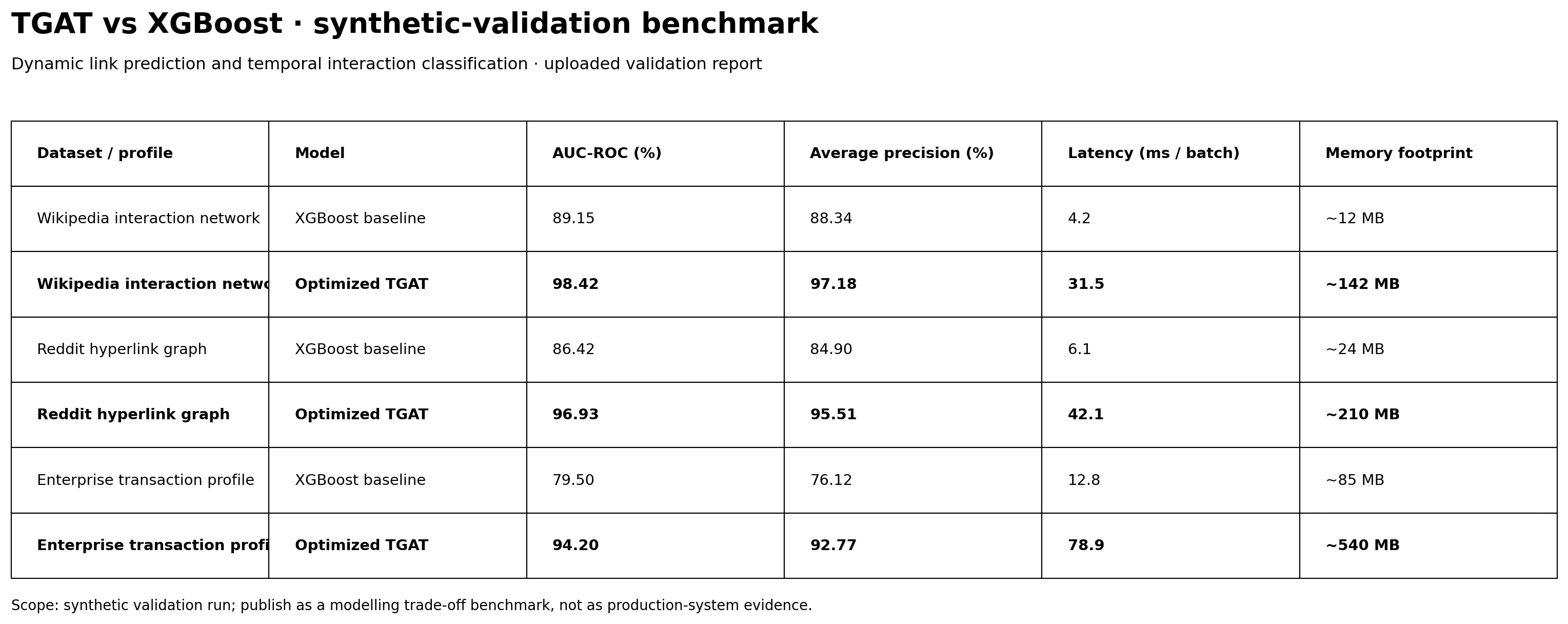
image evidence
TGAT versus XGBoost benchmark table
Synthetic-validation benchmark across Wikipedia interaction, Reddit hyperlink, and enterprise transaction profiles.
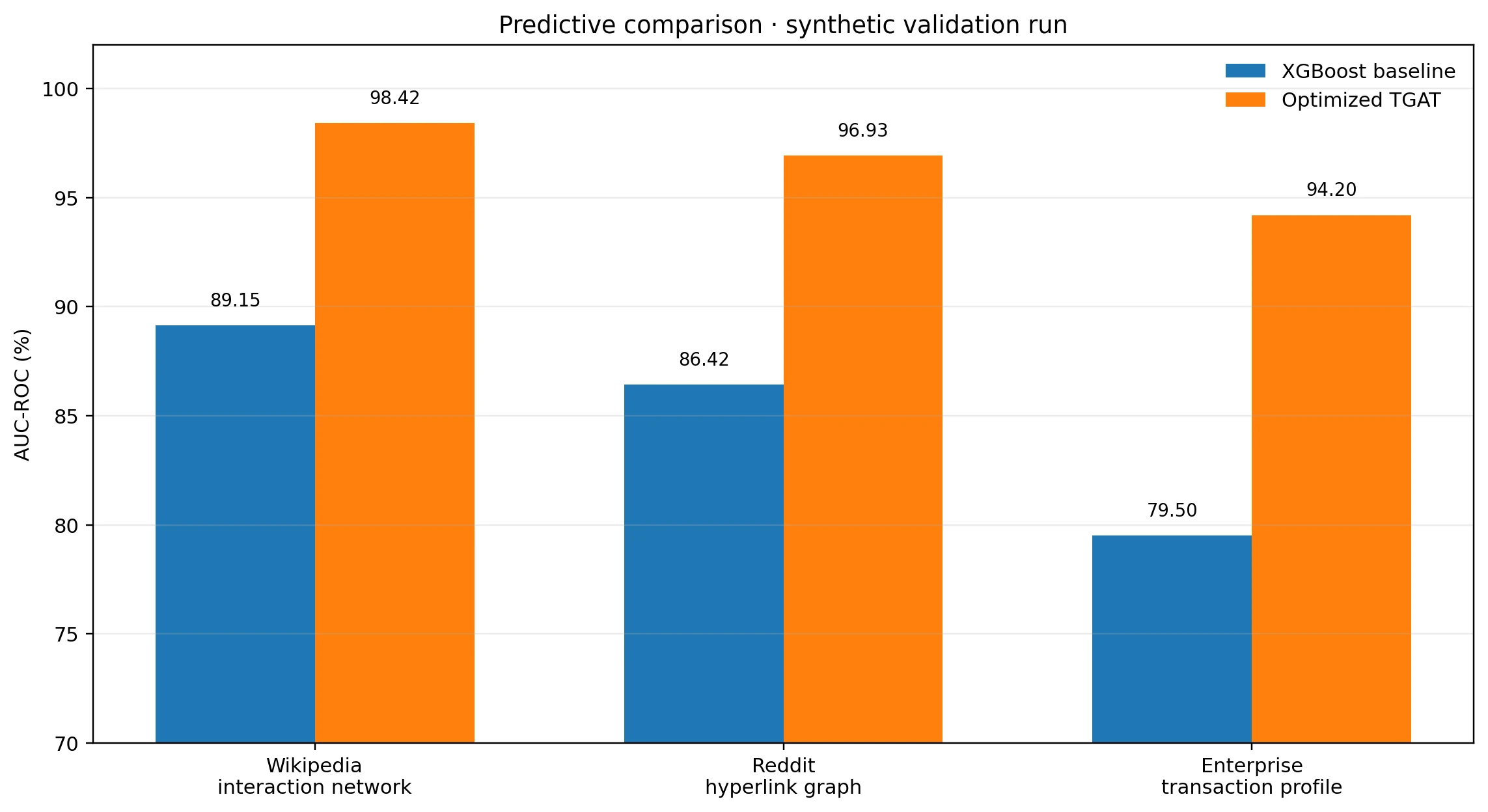
image evidence
TGAT and XGBoost AUC-ROC comparison
AUC-ROC comparison from the uploaded synthetic-validation report.
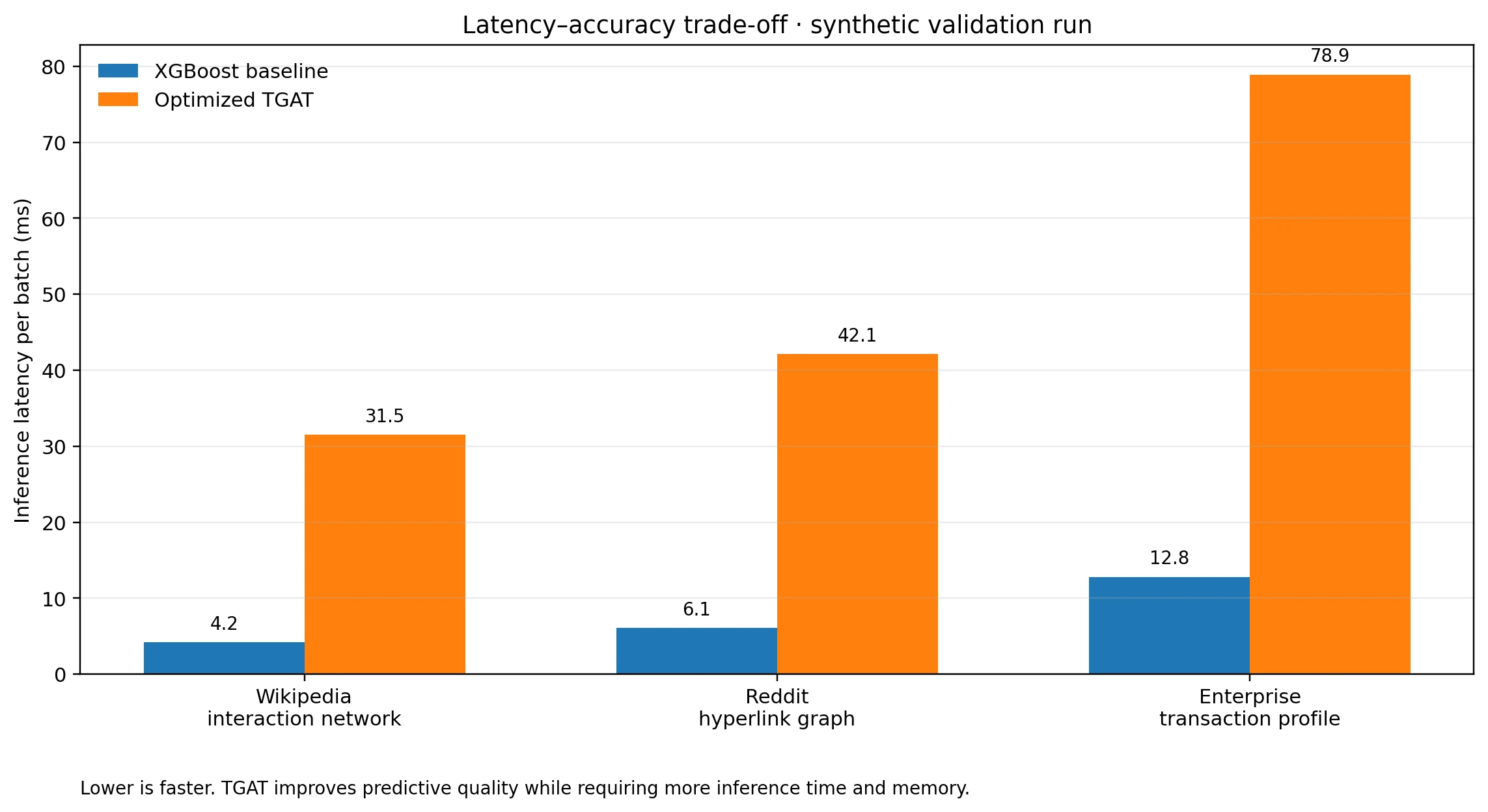
image evidence
Inference-latency trade-off
Per-batch latency comparison from the uploaded synthetic-validation report. Lower is faster.
Contribution
- Modelled dynamic interactions as a temporal graph.
- Built a TGAT-style validation path with continuous-time encodings and attention-based message passing.
- Compared predictive quality, latency, and memory trade-offs against a tabular XGBoost baseline.
- Label the public benchmark as synthetic validation rather than overstating production evidence.
Lessons
- Model choice should follow the structure of the problem.
- Higher predictive quality can carry meaningful latency and memory costs.
- Synthetic validation is useful when its boundary is explicit and the protocol is documented.
Limitations
- The public benchmark is a synthetic-validation run rather than a live production benchmark.
- The enterprise transaction profile is a representative validation scenario, not a disclosed client dataset.
- Deployment decisions still require dataset-specific reruns, calibration, and operational testing.
Stack
- PyTorch
- NetworkX
- TGAT
- Temporal GNNs
- XGBoost
- Fraud Detection
- Synthetic Validation